The Perfect Nasal Vaccine

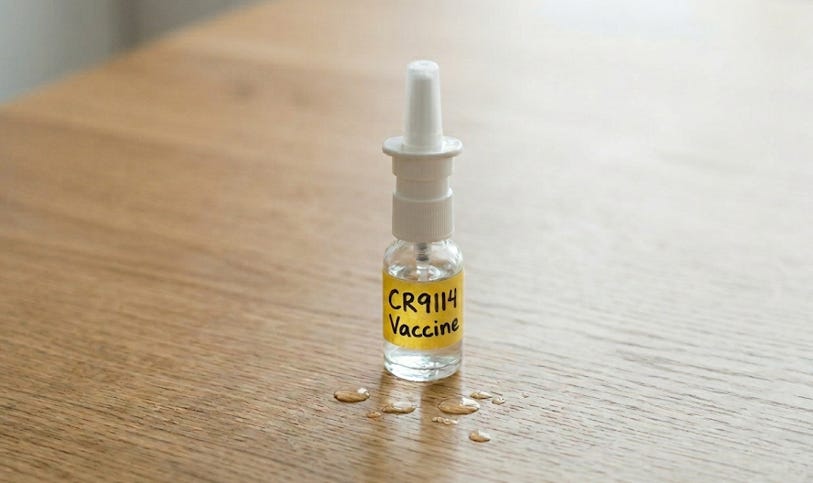
A few days ago, I got sick with the “super flu” and had to miss a lot of school. The strain was scientifically called H3N2 subclade K, and it had caused almost 90% of H3N2 cases, according to the CDC. This season’s flu vaccine was only partially effective, so many people got sick.
The reason this strain spread so widely is that it carries new mutations that help it slip past the immune protection from vaccines. This is just one example of vaccines being weaker against evolving targets. There are also cases of COVID-19 and RSV that are becoming harder for vaccines to keep up with.
The solution to this huge issue is a vaccine that can protect against multiple variants, like a universal vaccine. The issue is that these tend to either be less effective than strain-specific vaccines, or require more dosing. However, studies show new ideas that are groundbreaking for the field. In this first newsletter of a series, we will explore what I thought was an intranasal flu vaccine but is actually something more interesting.
To understand this solution, we need to understand how vaccines work.
How do vaccines work?
Well, to understand vaccines, we need to understand how our body helps stop threats using “soldiers” called the immune system. The immune system has many kinds of these “soldiers” for multiple cases. The most important ones are the innate immune cells, T cells, B cells, and memory cells. They have different tasks to help save our body from threats.
First, we have innate immune cells. These cells are a broader category that includes neutrophils, macrophages, and natural killer cells. These are basically the first cells to respond to a threat by using simple systems to find threats, almost like speedy emergency response teams. The most important innate cells are dendritic cells, which detect a threat and then tell T cells about this threat.
When the T cells hear about this threat, they do different things according to their role. Helper T cells command other immune cells to destroy the threat using chemicals called cytokines. Killer T cells, on the other hand, kill any cell that is contaminated with the threat, to stop the spread of the threat. Anyways, the helper T cells command B cells to create weapons.
These weapons are called antibodies, and they can bind to a foreign threat like a virus or a toxin. This allows the threat to be neutralized and gone. However, even when the threat is over for now, it can still come back. That is why memory cells remember these antibodies and how they were made just in case the threat comes back.
Now we know how the immune system responds to threats, let’s move on to vaccines, which might feel like an unknown treasure to some.
Vaccines are biological tools that train the immune system to prevent infections. Most vaccines, from the COVID vaccine to the measles vaccine, use parts of a virus, called antigens, to trigger an immune response. The COVID vaccine uses mRNA, which instructs cells to make the antigen inside the body, and the measles vaccine uses a weakened live virus, just as two examples.
When these antigens enter, they cause a reaction in the immune system, causing side effects like light fever or pain. However, this reaction is weaker, like playing a shooter game instead of shooting others in war. Nevertheless, the dendritic cells get activated and send the antigen details to the helper T cells. These T cells recruit B cells to create antibodies using this antigen. Later, the memory cells memorize the antibodies for use when the real virus comes.
However, as seen with COVID-19 every 6 months, viruses can mutate and avoid the defenses of vaccines almost like a tug of war. One reason behind this is that the antigens from vaccines are always changing in viruses. To solve this problem, scientists took the first step of discovery by discovering a new vaccine that can kill influenza. You might be wondering what this vaccine is?
What is the new flu vaccine by scientists?
First, unlike many antigen vaccines that create a threat, this is just the antibody, or the missile to destroy the virus. However, many antibodies do not work because they target regions of the influenza virus like the head of the spike protein, which can change at any time.
The solution is an antibody called CR9114, which binds to the stem of the spike protein, the part of the virus that changes the least over time. This allows it to work against all kinds of flu, like Influenza A and B, which are very different from each other. However, effectiveness can get better without an injection.
The reason is that injected antibodies travel through the blood, but influenza is mostly a respiratory infection. The virus replicates in the cells lining the nose and lungs, and often never establishes a significant presence in the blood at all. That means antibodies sitting in the bloodstream may never meet the virus where it actually does damage.
The solution is a relief for people who hate injections: a nasal spray. This works because the flu enters through the nose, so the antibody is already waiting at the front door instead of guarding a back room. The results were much better, with 100% protection in mice at intranasal doses as low as 0.6 micrograms per milliliter, compared to 10 micrograms per milliliter required when given by injection. This nasal formulation was also tested in humans.
This formulation is also safe, with no serious adverse events reported during the study.
However, there is a limitation to address, as nothing is perfect in science. These antibodies have a half-life of about 3 hours, meaning that half disappear every 3 hours. The reason is that the nose has a lot of defense mechanisms, like mucus that flushes out particles, to stop dangerous threats. This is a much shorter window of protection than traditional vaccines provide. So, strictly speaking, this isn’t a vaccine at all, it’s a prophylaxis, meaning a treatment given before exposure to prevent infection. However, this prophylaxis can be more effective with repeated dosage.
The study showed that after 5 days of twice-daily dosing, antibody levels in the nose were 92 times higher than after a single dose. This means that there is still some hope for this prophylaxis, even if it is not a vaccine. Besides, the potential applications are astounding, from protection against the recent super flu outbreak to the bird flu outbreak that is devastating chicken egg production. In the future, researchers may be able to extend the half-life from 3 hours to several days, possibly using delivery methods like the lipid nanoparticles used in mRNA vaccines.
In the meantime, subscribe to my newsletter so that you can gain more information about that breakthrough. Plus, you can also get the next installment of The Next Vaccine series in your mail.